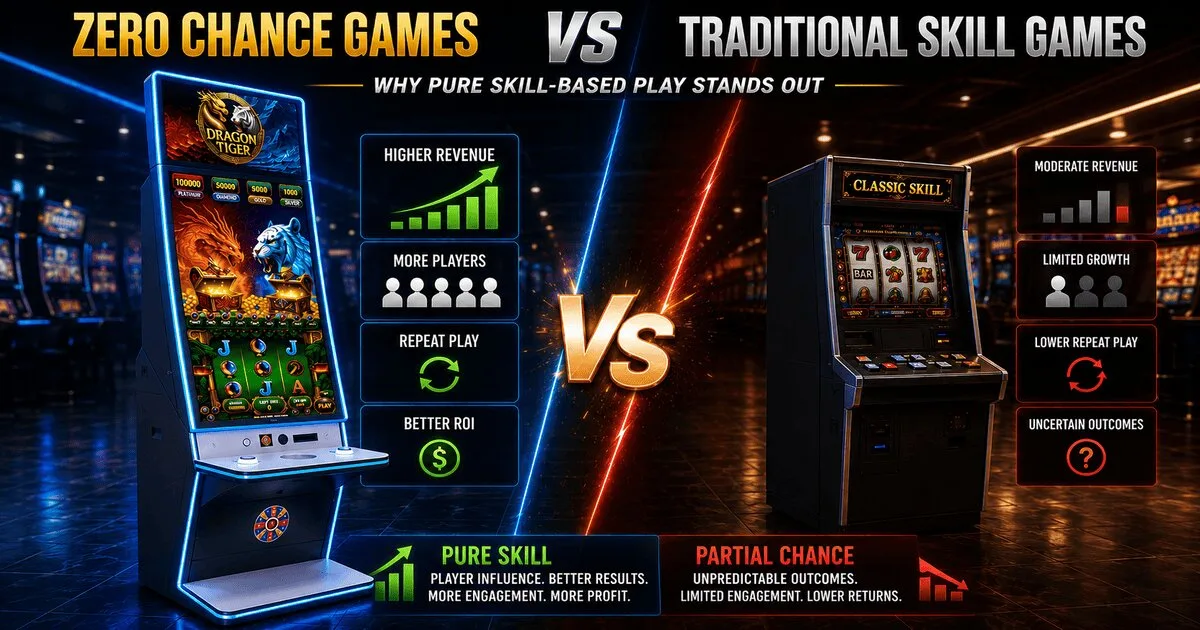
Zero Chance Games vs. Traditional Skill Games: Side-By-Side Comparison
| Factor | Traditional Skill Games | Zero Chance Games |
|---|---|---|
| Payment method | Coins, tokens, fixed-denomination bills | Any bill denomination, full credit |
| Change handling | Required (coin mech, change machine, or cashier) | Not required |
| Reporting precision | Coin-count based estimates | Exact dollar tracking |
| Hardware complexity | Coin mechs, token dispensers | Bill acceptors only |
| Staff dependency | Higher (change fund management) | Lower |
| Upfront cost | Lower (especially secondary market) | Higher (newer format) |
| Network integration | Varies widely | More common |
| Best suited for | Established venues, budget-conscious operators | High-traffic, lean-staffed locations |
Zero Chance Games credit players for the full value of any bill inserted, eliminating the need for change handling. This simplifies operations, reduces maintenance related to change mechanisms, and allows operators to spend less time managing change funds.
Traditional skill games have been a staple in amusement and gaming locations for years. Players insert money, receive credits or change when applicable, and enjoy a familiar experience supported by well-established hardware and operating procedures.
What Are Traditional Skill Games?
Traditional skill games are player-operated amusement machines where success depends on the player's ability, timing, or decision-making. Claw machines, stacker games, and basketball shooters all fall under this category. What makes them "traditional" isn't just the game mechanics. It's the payment architecture. These machines were built around coin and token economies, and many still operate that way today.
A significant portion of the installed base in the United States still runs on quarters or location-specific tokens. As a result, operators often need to manage:
- Change funds
- Token inventories
- Coin mechanism maintenance
- Bill validator servicing
- Cash-handling equipment
How Traditional Skill Games Work?
The player approaches the machine with currency, whether that's coins, tokens, or bills depending on the machine configuration. The machine converts that value into a fixed number of credits and gameplay begins.
A typical transaction process looks like this:
- The player inserts money.
- Credits are assigned at a fixed rate.
- Gameplay begins.
- Additional funds can be added if needed.
- Change is handled through the machine, a change machine, or a cashier.
If a player inserts more money than required for a game, the remaining value must be managed elsewhere. That extra step can introduce operational friction.
Common examples include:
- Coin mechanisms jamming
- Change machines running low during peak hours
- Cashiers being unavailable when needed
These aren't major problems individually, but they do require attention and ongoing maintenance.
Why Operators Continue Using Traditional Skill Games
The honest answer is familiarity and cost. Traditional skill games are available at nearly every price point in the secondary market. Distributors carry large inventories, replacement parts are easy to find, and service technicians already know how to work on the equipment.
Common reasons operators continue using Traditional Skill Games include:
- Lower upfront investment
- Strong secondary market availability
- Established service networks
- Accessible replacement parts
- Familiar player experience
- Proven operating history
For operators managing older venues or working within tighter budgets, replacing traditional equipment doesn't always make financial sense when existing machines continue producing consistent revenue.
There's also a player familiarity factor. Guests who grew up feeding quarters into claw machines don't find that process unusual. The friction is often viewed as part of the experience itself, and some operators believe it can even increase perceived value.
What Are Zero Chance Games?
Zero Chance Games are a newer format designed to remove cash-handling friction at the machine level. Instead of requiring exact change or tokens, players insert bills and receive the full value in credits displayed on screen.
When gameplay ends, unused credits are typically resolved through:
- Printed tickets
- Redemption receipts
- Centralized redemption systems
- Networked account systems
The core design principle is speed. The goal is to reduce the time between a player deciding to play and actually starting the game.
Players don't need to:
- Search for quarters
- Purchase tokens
- Visit a change machine
- Wait for a cashier to break larger bills
How Zero Chance Games Work?
The process is designed to be straightforward.
- The player inserts a bill.
- The machine reads the denomination.
- Full value is credited immediately.
- Gameplay begins.
- Remaining value is managed through the machine's redemption system.
No coins are returned and no separate change transaction is required.
Many Zero Chance Game systems are also connected to centralized management platforms, allowing operators to track activity in real time.
This can provide visibility into:
- Live credit balances
- Revenue by machine
- Play frequency
- Performance trends
- Location-level analytics
Why Zero Chance Games Are Gaining Attention?
From an operator's perspective, Zero Chance Games help address several common operational challenges.
Locations with high foot traffic and limited staffing can't always redirect players to a change machine or cashier. By handling the conversion automatically, Zero Chance Games help reduce friction and increase convenience.
Operators are often attracted to benefits such as:
- Reduced cash handling
- Simpler reporting
- Cleaner revenue tracking
- Fewer payment-related interruptions
- Lower staff dependency
- Better support for networked operations
There's also a reporting advantage. Because every dollar inserted is tracked digitally, revenue reconciliation is often easier than relying on coin counts or manual estimates.
For operators managing multiple locations, that additional visibility can make day-to-day operations much easier to oversee.
Why Operations Matter More Than Many Operators Realize?
Most purchasing decisions in arcade game operations focus on game themes and player appeal, understandably. But the operational layer is where margins actually get made or lost. A machine that generates strong gross revenue while requiring daily coin refills, a dedicated cashier, and frequent mech servicing may produce lower net revenue than a simpler machine that runs without intervention for a full week.
Distributors who help operators think through these trade-offs build stronger relationships. The conversation shouldn't just be "this game is popular." It should also be "here's what running this game actually looks like at your location type."
Managing Multiple Locations Changes Everything
A single-location operator can often manage inefficiencies through direct oversight.
- The owner is present.
- Machines are nearby.
- Issues can be resolved quickly.
The situation changes when additional locations are added.
As operations grow, operators often face:
- More collection schedules
- More service requests
- More machine monitoring requirements
- More reporting responsibilities
- More opportunities for human error
What worked perfectly at one location may become difficult to manage across five or ten locations.
This is one reason many growth-focused operators place greater emphasis on operational efficiency when evaluating machine formats.
Reporting Becomes a Competitive Advantage?
This point doesn't get enough attention. Operators who can tell you exactly how much each machine earned last Tuesday have a meaningful edge over those working from weekly cash counts and rough estimates.
Zero Chance Games, especially those on networked management platforms, make granular reporting straightforward. You can see which machines are underperforming, which locations have high play frequency but low revenue per session (a sign of low credit pricing), and when peak play hours occur. That data shapes restocking decisions, placement decisions, and pricing adjustments.
Traditional skill games can be networked too, but the secondary market machines that make up a large portion of installed fleets often aren't. You're working with cash counts and manual logs, which are functional but slow. In a multi-location operation, slow data means slow decisions.
Technology Is Becoming A Bigger Part Of Operations
Technology has changed how many operators manage their businesses.
Modern management platforms provide visibility into machine performance, collections, support activity, and location trends without requiring constant site visits.
RedPlum Connect allows operators to monitor machines, locations, collections, kiosks, machine balances, technician activity, support tickets, and performance reports from a centralized platform. Automated email updates also provide daily collection summaries and operational insights.
For operators managing multiple locations, having access to accurate data can improve decision-making and reduce administrative workload.
4 Common Mistakes Operators Make When Choosing a Format?
Choosing the wrong format doesn't always happen because of the games themselves.
It often happens because operators focus on short-term factors and overlook long-term operational needs.
1. Choosing Based Only On Game Themes
A zero chance game with mediocre gameplay won't outperform a well-themed traditional skill game just because the payment system is more convenient. Player experience still matters. The format should support the game, not substitute for it. Distributors can help operators think through this pairing more carefully.
2. Ignoring Future Growth
Operators planning to expand should be factoring format decisions into their growth model now. A fleet of traditional coin-op machines that works fine at one location can become a logistics problem at five. It's not always necessary to switch formats immediately, but it's worth understanding the trade-off before it becomes urgent.
3. Overlooking Redemption Workflows
Zero Chance Games typically output tickets or printed receipts rather than coins. That means the redemption side of the operation needs to be set up to handle it: a central kiosk, a staffed counter, or a hybrid system. Operators who add Zero Chance Games without adjusting their redemption workflow create a different kind of friction downstream.
4. Underestimating Reporting Needs
Operators who don't currently use machine-level reporting often assume they don't need it. But the absence of reporting usually means they're making placement and pricing decisions based on intuition. When those decisions are wrong, there's no data to indicate why. Starting with a format that generates clean reporting (even if it's not immediately used) builds a better foundation.
Which Format is Better for Your Business?
There's no universal answer, and any distributor or supplier claiming otherwise is oversimplifying. The more useful frame is: what does your operation actually look like, and what problems are you trying to solve?
If you're supplying machines to a high-traffic venue with limited staffing, Zero Chance Games reduce the operational burden on that location, which tends to extend machine uptime and improve your service relationship. If you're working with budget-conscious operators rebuilding older fleets, traditional skill games on the secondary market may be the practical choice, especially if those operators aren't ready to invest in new management infrastructure.
The strongest positions in this industry aren't built on choosing one format exclusively. They're built on understanding what each format does well and matching it to the right location type.
Final Thoughts
The difference between Zero Chance Games and traditional skill games is real, and it extends well past how players insert money. Payment architecture affects service frequency, cash handling labor, reporting quality, and how well a fleet scales across multiple locations. These aren't trivial operational details. They're the variables that determine whether a route is profitable or just busy.
Operators who take the time to understand the differences between Zero Chance Games and Traditional Skill Games are often better prepared for long-term growth. The right format can influence reporting, machine management, labor requirements, and overall operational efficiency. As businesses expand into more locations, those factors become increasingly important. At RedPlum Games, we believe the most successful operators evaluate both the player experience and the operational impact before making a decision. That's the real value of getting this choice right from the start.
FAQs
1. What makes Zero Chance Games different from standard skill games?
Zero Chance Games remove chance-based outcomes and ensure every result is determined by player decisions. Traditional skill games may include varying gameplay mechanics, while Zero Chance Games focus entirely on skill, strategy, and player control.
2. Which game format do players prefer: Zero Chance Games or traditional skill games?
Player preference varies by location and experience level. Some players enjoy the familiar feel of traditional skill games, while others prefer Zero Chance Games because outcomes are based entirely on their decisions rather than any chance element.
3. Why are Zero Chance Games becoming a popular alternative to traditional skill games?
Many players enjoy Zero Chance Games because they offer more control over outcomes. Success depends on decision-making and strategy, creating a more engaging experience for players who prefer skill-based entertainment over games influenced by chance.
4. Are Zero Chance Games easier to manage?
Many operators believe so, particularly when managing multiple locations. Simpler payment workflows and more precise reporting can reduce administrative effort.
5. Is a Zero Chance Game better for multi-location operations?
It depends on the operator's goals and infrastructure. Many multi-location operators prefer Zero Chance Games because they simplify payment handling, improve reporting accuracy, and reduce some of the operational challenges associated with managing machines across several locations.
Related product
Solaris Game Cabinets
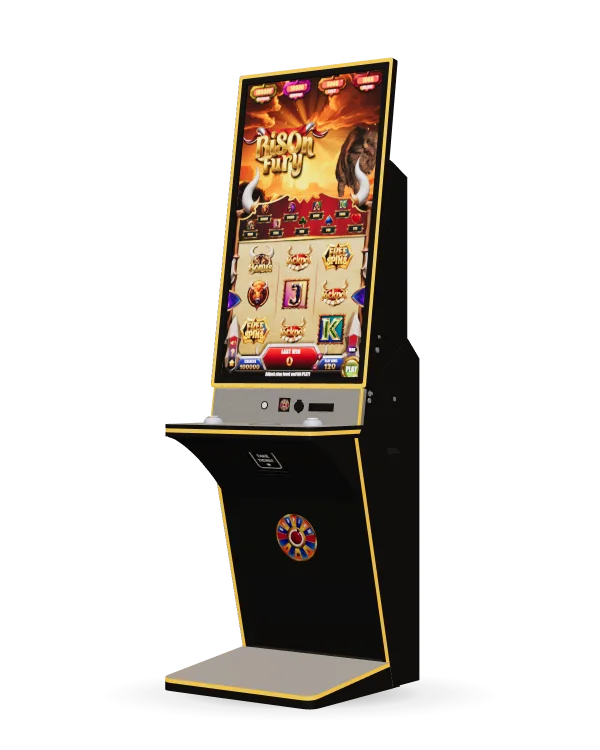
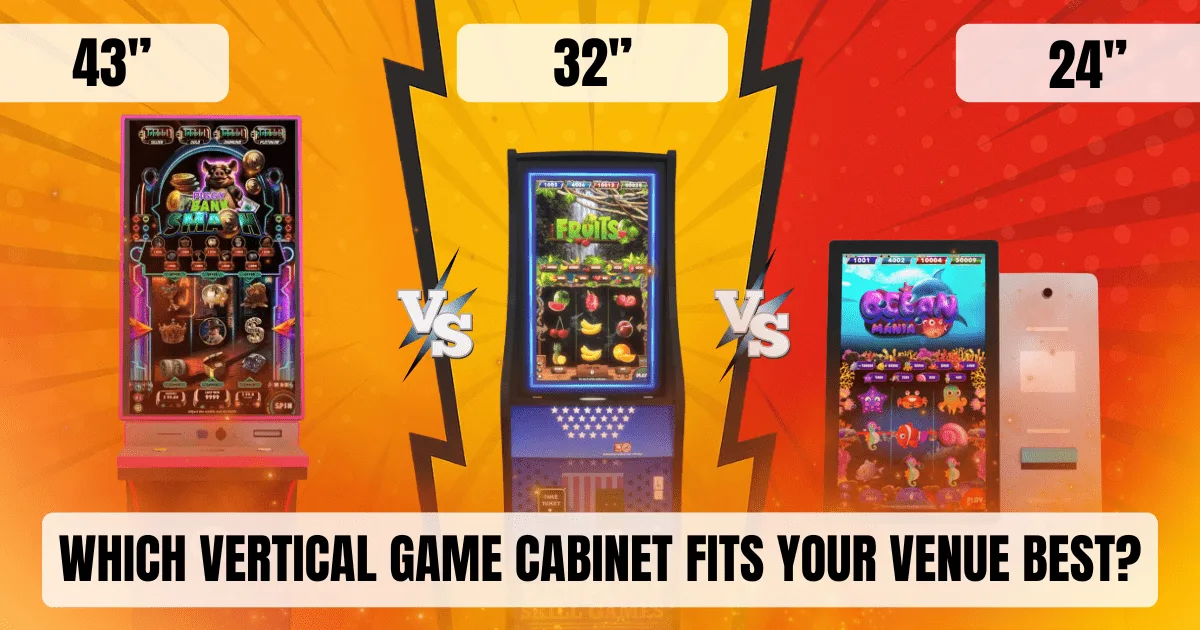
A 43-inch touchscreen in a cold-rolled steel body, with a curved, flat or J-panel display. Every cabinet runs the RedPlum game library and prints encrypted tickets your kiosks pay out.
Explore zero chance games